Most Mobility Habits Fail Here’s What Works Instead
Most habit advice falls apart because it treats movement like an event you have to schedule, remember, and feel ready for. In real life, movement sticks better as a location-based memory cue: a tiny…
Most habit advice falls apart because it treats movement like an event you have to schedule, remember, and feel ready for. In real life, movement sticks better as a location-based memory cue: a tiny action tied to a place you already pass through when your day predictably stalls.
That is the idea behind a personal movement bookmark system. Instead of waiting for a workout window, you assign a 20- to 60-second pose, stretch, or breathing drill to a physical landmark: the edge of the bed, the bathroom sink, the kitchen counter, or the parked car before you walk inside.
I love this approach because it lowers the negotiation. The place does the reminding, and the movement is so small that motivation barely gets a vote.
What a movement bookmark actually is
A movement bookmark is one tiny practice attached to one specific place. Not a full routine. Not a productivity challenge. Just a reliable body reset that happens at a reliable landmark.
If you can do it in your regular clothes, in under a minute, without unfolding anything, it has a shot at becoming automatic.
If you’ve liked my posts on reducing mobility decision fatigue or making your space cue movement, this is the same principle made even smaller and more portable.
How to build your movement bookmark system
-
Choose 2-4 body areas that reliably ask for help.
Start with patterns, not ideals. You do not need a balanced full-body plan. You need the spots that complain most often during ordinary life.
- Neck and jaw after screens
- Wrists and upper back after typing
- Hips after sitting
- Feet and calves after standing or commuting
- Low back when you first get up or get out of the car
Pick the areas that show up at least four days a week. That gives your system something real to solve.
-
Match each body area to a place where your day already pauses.
You are looking for landmarks that already exist, not places you wish you used more. The cue should be embarrassingly obvious.
- Edge of the bed
- Bathroom sink
- Kitchen counter or kettle area
- Parked car before getting out
- Desk chair before sitting down again
- Hallway by the coat hooks
The best bookmark locations are places where you naturally stop for 10-30 seconds anyway.
-
Pick one movement simple enough to do without changing clothes.
This is where people usually overreach. A bookmark is not your “best stretch.” It is your most repeatable stretch.
Good bookmark movements tend to be:
- Standing or seated
- Low-sweat and low-drama
- Easy to remember
- Done in 3-5 breaths or 20-45 seconds
-
Add one visible cue, if needed.
Sometimes the place alone is enough. Sometimes it helps to give the place a tiny physical nudge. I like unobtrusive items that support the habit without turning it into a project.
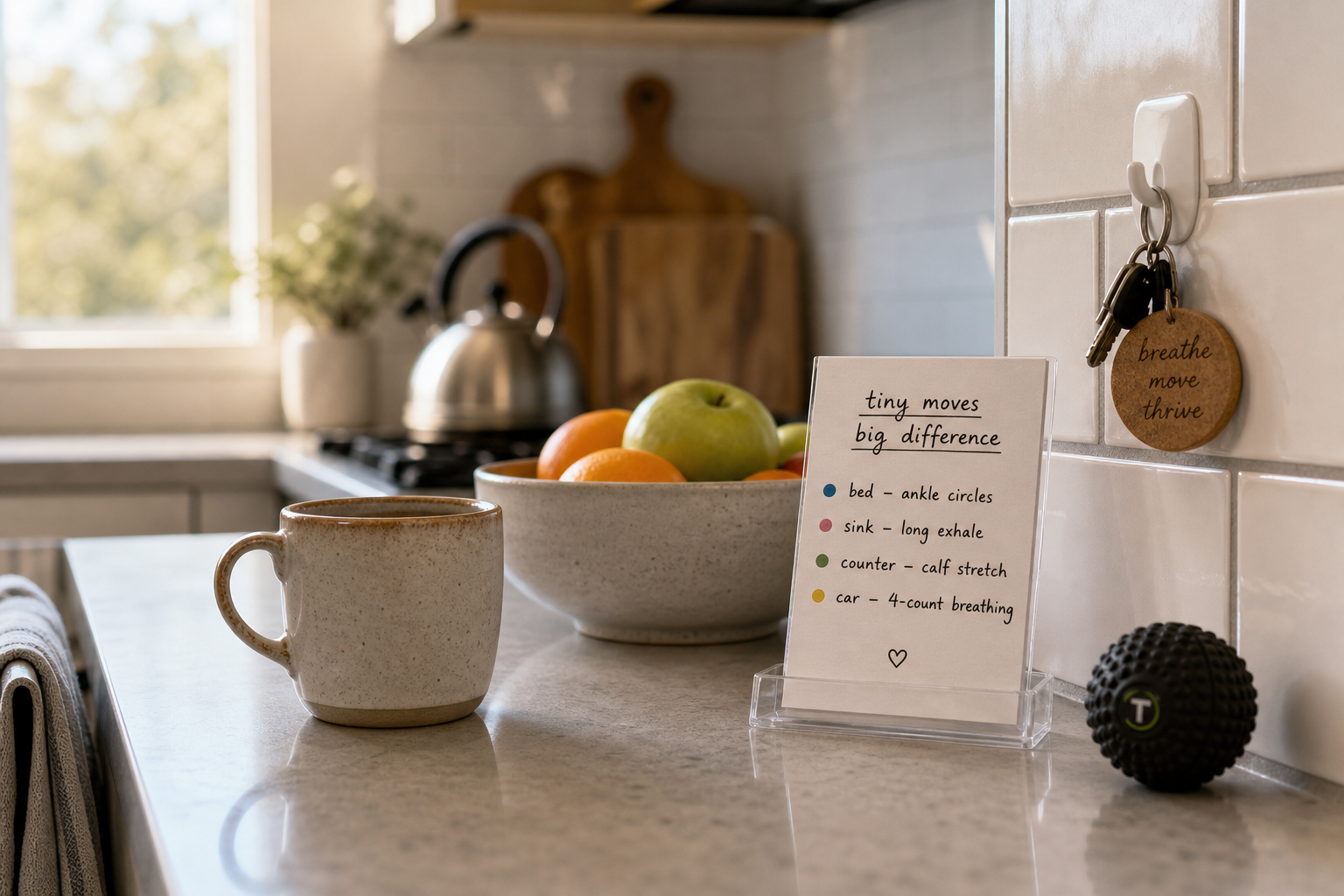
For example, a slim adhesive suction hook near the bathroom mirror can hold a tiny card, resistance band, or just mark the place as “this is where I exhale and drop my shoulders.” If you need something sturdier in a kitchen or entry, these heavy-duty adhesive hooks are useful for creating a consistent visual landmark.
-
Test the system for one week before improving it.
Do not keep editing on day two. Run the experiment first.
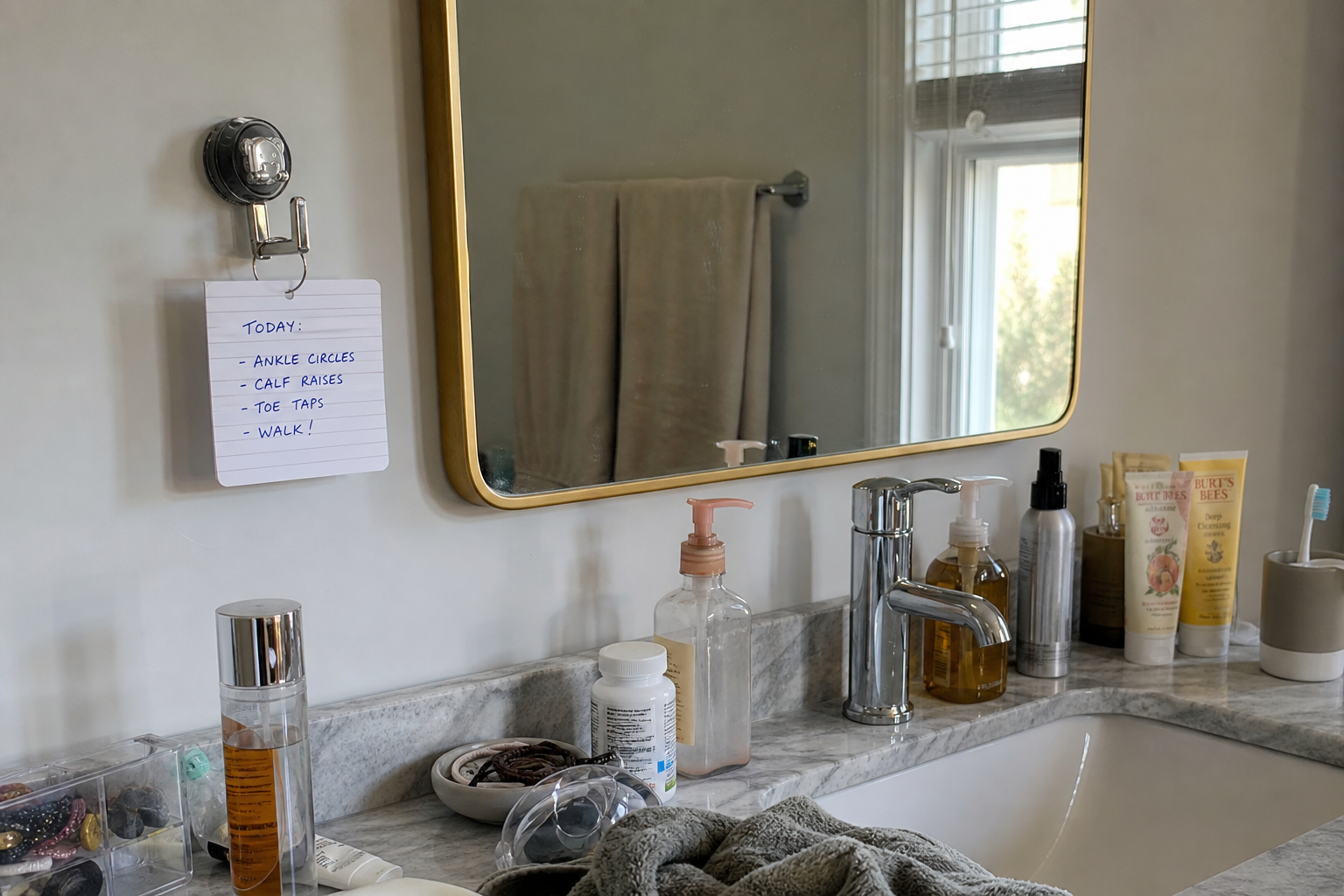
Four movement bookmark examples you can copy
Here are a few practical pairings to show you what “small enough” looks like.
-
Edge of the bed → seated ankle circles + one forward fold
Before standing up, circle each ankle a few times and fold forward over your legs for 3 breaths. This works well if your feet, calves, or low back feel stiff first thing.
-
Bathroom sink → shoulder shrug, roll, and long exhale
Hands on the sink, soften the knees, shrug the shoulders up, roll them back, then take 3 slow exhales. Great for neck tension and the slightly hunched phone posture most of us accumulate.
-
Kitchen counter → standing calf stretch or hip hinge reset
While the kettle runs or leftovers warm, place your hands on the counter and step one foot back for a calf stretch. Or hinge the hips back with a long spine for 3-5 breaths if your back feels compressed from sitting.
-
Parked car → seated twist or 4-count breathing
Before you get out, sit tall, gently twist right and left, or do five rounds of inhale for 4, exhale for 4. This is one of my favorite bookmarks because it catches the transition before you carry the whole commute into the next part of the day.
If your feet tend to ache or feel flat by late afternoon, a compact peanut massage ball tucked under a desk or by the couch can turn a bookmark into 20 seconds of foot rolling. And if you prefer a more textured feel, a spiky massage ball can work well for quick standing foot stimulation near a counter or coat rack.
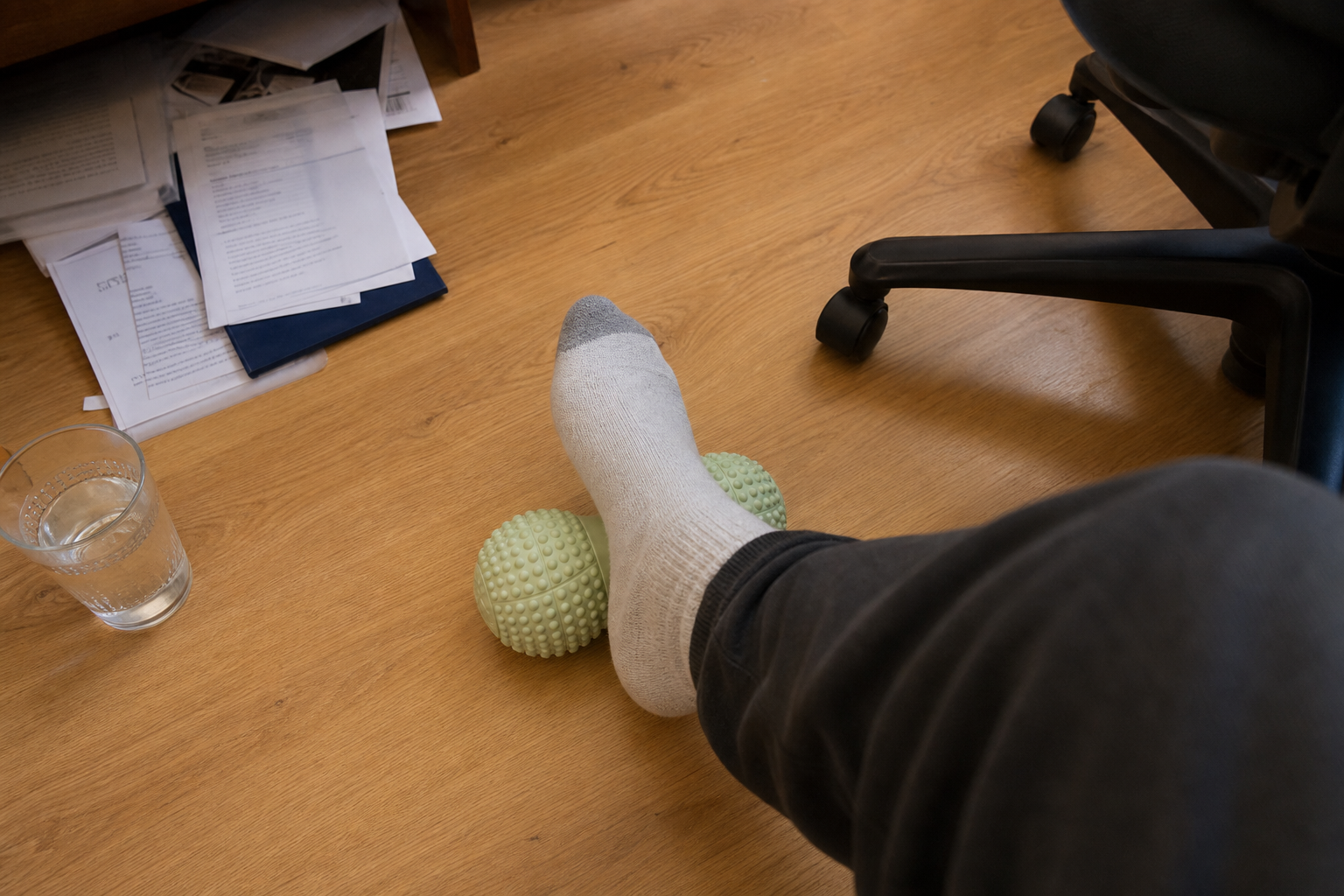
How to know if a bookmark is sticky
For one week, keep the test simple. You are not grading flexibility. You are checking whether the cue and action find each other consistently.
-
Track only three things:
- Did I notice the place?
- Did I do the movement?
- Did it feel neutral, pleasant, or annoying?
-
Aim for recall before perfection.
If you remembered the bathroom sink bookmark and only took one long exhale, I still count that as a win. Memory comes before duration.
-
Look for a 70 percent hit rate.
If a bookmark shows up on most days without a big internal debate, it is sticky enough to keep.
-
Swap anything that creates friction three times in a week.
Resistance is useful information. If you repeatedly avoid a bookmark, the movement is probably too ambitious, too awkward for the setting, or attached to the wrong place.
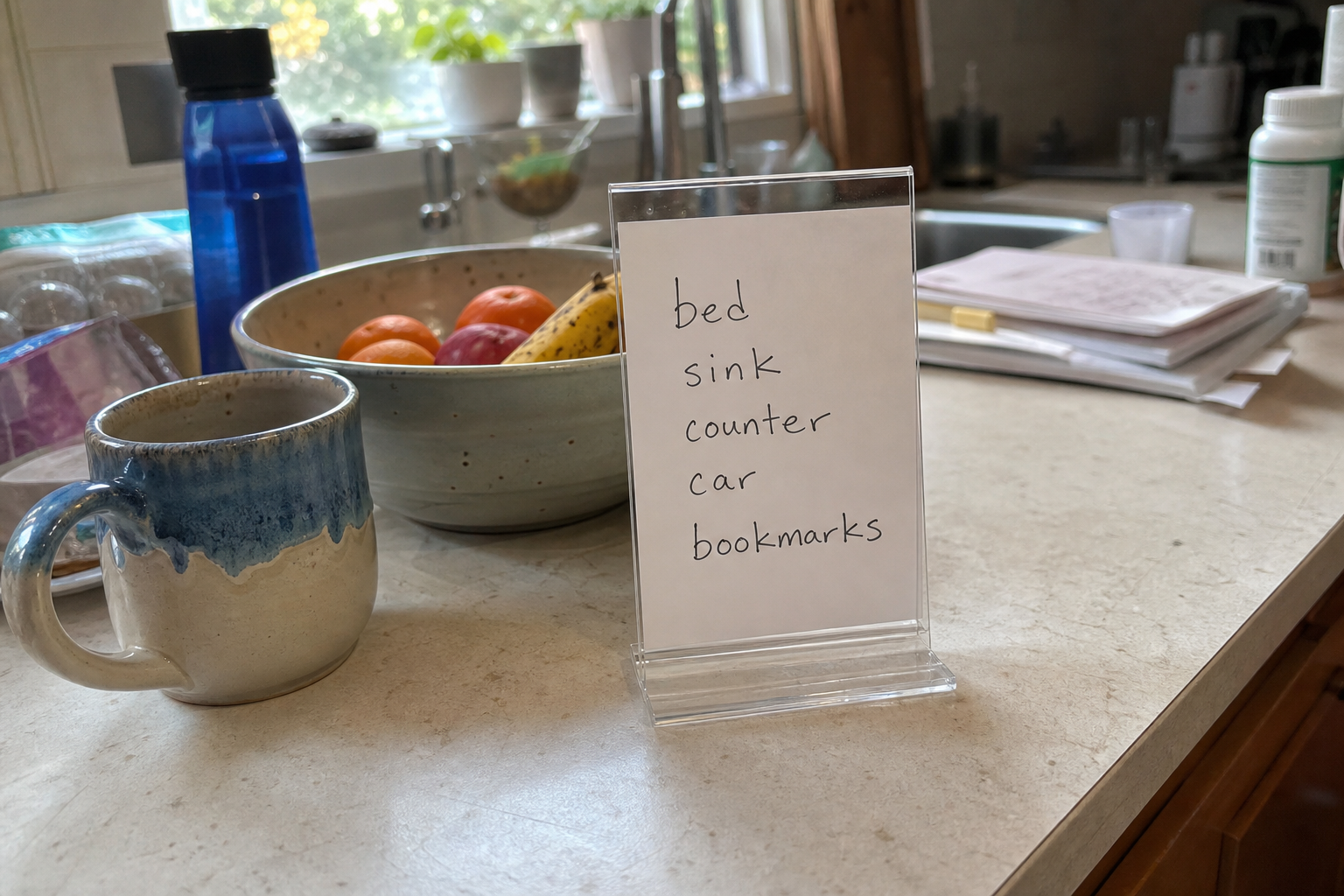
If you like visible prompts, a small acrylic sign holder on a counter can hold a tiny handwritten card with your 3-5 bookmarks. That sounds almost silly, but external memory is often what makes a habit feel effortless instead of noble.
Troubleshooting the three most common problems
1. You forget entirely
This usually means the landmark is not distinct enough, or there is no visible cue.
- Move the bookmark to a more obvious pause point
- Add a cue card, hook, or object that visually interrupts autopilot
- Reduce the movement to one breath or one rep for a few days
2. You overcomplicate it
If one bookmark quietly becomes a mini routine, it will start to feel expensive.
- Cap it at 60 seconds
- Use only one movement per place
- Save “bonus” stretches for times you actually want more
3. The movement is too ambitious
This is common when people choose floor work, deep holds, or anything that needs privacy, warm muscles, or athletic enthusiasm.
Caution: if a bookmark makes you brace, strain, or hold your breath, it is too much for this role. Bookmark movements should feel accessible and repeatable, not like a flexibility test.
- Swap deep stretches for gentler versions
- Trade intensity for breath count
- Choose motions that fit your actual clothes and environment
A few support items that help without creating gear clutter
I’m very pro low-friction support and very anti turning every habit into a shopping list. If you want a little scaffolding, these are the kinds of items I’d keep simple and specific:
- A wall cue: an adhesive suction hook or stainless adhesive hook to mark a bookmark zone
- A visual reminder: an small acrylic sign holder for a handwritten cue card on the kitchen counter or desk
- A tactile reset: a peanut massage ball or spiky foot massage ball by the desk, couch, or entry bench
I would skip the more complex electrical programmable timer switch for this purpose unless you already know exactly why you need it. For most people, a bookmark works better when the cue is physical and obvious, not technical.
When to swap a bookmark out
Change a bookmark if:
- You keep skipping it with the same little sigh
- The place is too rushed or inconsistent
- The movement feels awkward in work clothes
- You need to remember too many steps
- It helps in theory but never happens in practice
Do not label that failure. It is just poor matching. Keep the body area, change the location or simplify the movement.
Closing Thoughts
A movement bookmark system works because it borrows memory from places you already visit instead of asking motivation to do all the heavy lifting. Choose a few body areas that reliably need attention, pair each one with a daily landmark, and keep the movement almost laughably short. If a bookmark feels annoying or too ambitious, swap it early rather than forcing it. The goal is not a perfect routine; it is scattering enough mobility into your day that it happens before resistance has time to form.
Disclaimer: As an aliexpress Associate, I earn from qualifying purchases.